
The idea of growing a replacement tooth naturally is compelling. Headlines about a “tooth regrowth drug” have brought that possibility to a wider audience.
There is real science behind the discussion. However, repairing dental tissues, stimulating tooth development, and reliably replacing a missing adult tooth are different goals. Progress toward one does not prove that all are ready for everyday care.
What is regenerative dentistry studying?
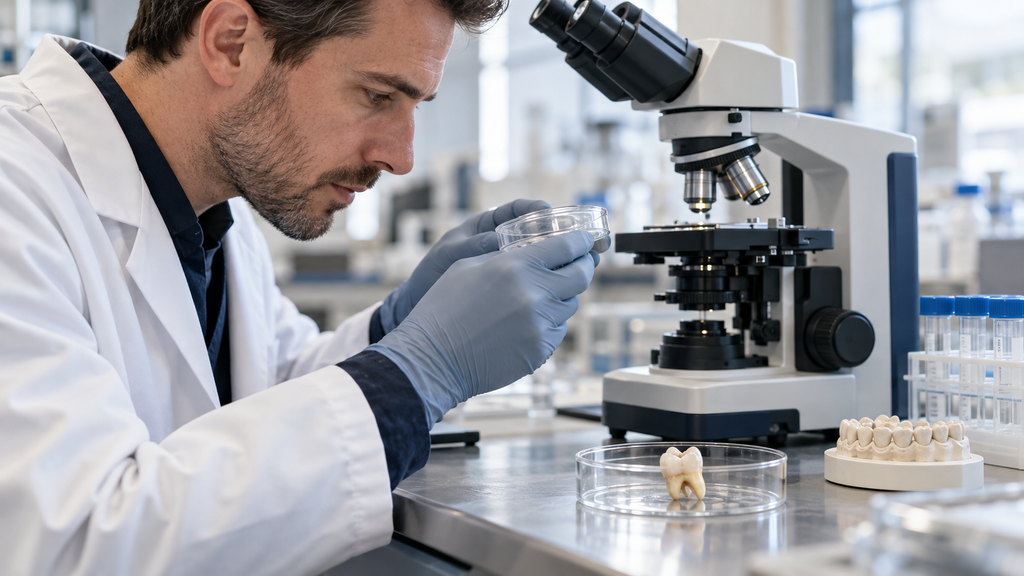
NIDCR’s regenerative medicine overview, reviewed in January 2026, describes research involving stem cells, biomaterials, and targeted therapies intended to repair dental tissues or stimulate tooth development.
Some projects explore materials that guide tissue healing. Others examine the biological signals involved in development. These approaches still require careful evaluation before experimental findings can become predictable treatments.
What is the tooth regrowth drug?
Kitano Hospital announced a first-in-human trial plan in May 2024 for TRG035, an investigational antibody targeting a protein called USAG-1. Its research program is aimed at congenital tooth absence—teeth that never developed.
The announcement described the initial human study as primarily a safety and dosage investigation. A safety study is not the same as demonstrating that a therapy reliably grows functional teeth in patients.
What changed in 2026?
On August 17, 2026, developer Toregem BioPharma announced that Japan’s PMDA had completed its required investigation of a clinical trial notification for an exploratory Phase IIa trial of TRG035 for congenital tooth agenesis.
This is a clinical-development update reported by the company developing the drug. It is not a peer-reviewed efficacy result, marketing authorization, or proof that the therapy works for people who lose teeth from decay, injury, or gum disease.
Why are the distinctions important?
Someone born without certain teeth may have different treatment needs from an adult whose fully developed tooth was extracted. Results in one population cannot simply be assumed to apply to another.
Patients reading future announcements should look for published human results, the condition studied, safety findings, and regulatory status—not only projected availability dates.
What should patients do today?
Research provides reasons to follow this field with interest. It does not provide a reason to postpone assessment of a missing or damaged tooth.
If you are considering tooth replacement, discuss established options with your dentist. Future discoveries are worth watching while today’s decisions remain grounded in your current needs and available evidence.